The PeriFlux System 5000 is the fifth generation of Perimed's PeriFlux instrument range for blood perfusion measurements. It has the output parameters required by the general user and complements the advanced PeriFlux System 4000 which is the number one choice for the advanced researcher.
The PeriFlux System 5000 is a compact, easy-to-use, multi-functional system. It consists of one Main Unit that is equipped with up to 4 Function Units. There is complete freedom to install the appropriate Function Units required for your application and complement it with a selection from our wide range of standard/custom-made probes. Combining different functions in one instrument saves space, reduces cost and increases user-friendliness.
|
| |
 Principle of Laser Doppler Principle of Laser Doppler |
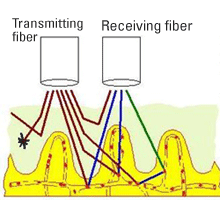
Light is transmitted to the tissue via a fibre-optic probe. When this light hits moving blood cells, it undergoes a change in wavelength (Doppler shift). The magnitude and frequency distribution of these changes are directly related to the number and velocity of blood cells, i.e. the blood perfusion.
Measurements are expressed in arbitrary Perfusion Units (PU). Full linear correlation to absolute perfusion values is achieved using Perimed's innovative analysis technology (including a linearization function to avoid underestimation in highly perfused tissues) and calibration using automatic instrument zeroing and Perimed's Motility Standard.
|
| PeriFlux 5001 Main Unit |
The PeriFlux 5001 Main Unit can host up to four Function Units of different types. The Main Unit has a digital output for connection to Perimed's dedicated software, Perisoft, or directly to a printer. It also has an analog output for connection to pen recorders or computer systems. Alternatively it can be used stand-alone, without external data acquisition systems.
|
| Function Units |
The Function Units are designed to meet specific needs in different applications. To optimize the system, the customer can choose the appropriate unit to meet particular requirements. Additional Function Units can easily be subsequently installed by the user.
|
| PF 5010 LDPM Unit |
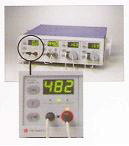
For real-time microvascular perfusion measurements. The system uses the laser Doppler probes to allow measurements in virtually all tissues, invasively or noninvasively.
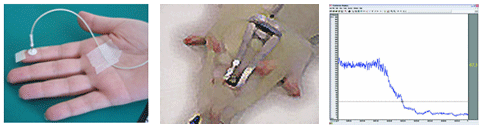
Laser Doppler has been extensively used for tissue evaluation on skin and most other organs (see Perimed Literature Reference List containing more than 2000 research articles).
|
- Management of peripheral vascular disease
- Diabetes treatment
- Amputation level determination
- Monitoring therapy
- Evaluation of flaps
- Treatment of burns
- Wound healing
|
| PF 5020 Temp. Unit |
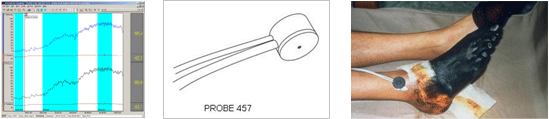
“Heat provocation”
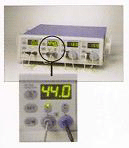
Local heating can be used for heat provocation. The reactive hyperaemia following heat provocation is monitored by the PeriFlux laser Doppler. The microcirculatory response to the heat indicates the vascular capacity of the tissue. Such measurements can be used to determine The viability of tissues with impaired micorcirculation.
"Temperature stabilization”
For reproducible skin perfusion measurements without temperature provocation, it is important to maintain a constant skin temperature. If is an easy way to stabilize the local skin temperature when a temperature-controlled room is not available.
|
| PF 5040 tcpO₂/ pCO₂Unit |
“Oxygenation and tissue metabolism with cpO₂/ pCO₂measurements"
Transcutaneous monitoring of oxygen and carbon dioxide, originally developed for neonatal use, is nowused in a number of different applications, including vascular and wound care, plastic surgery, hyperbaric medicine and orthopaedic surgery.
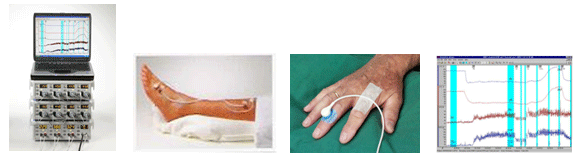
“Multi-channel tcpO₂/ pCO₂and Blood Perfusion monitor”
System 5000 is unique in permitting up to four channels of tcpO₂/ pCO₂and laser Doppler in any combination. |
|
| PF 5050 Pressure Unit |
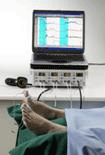
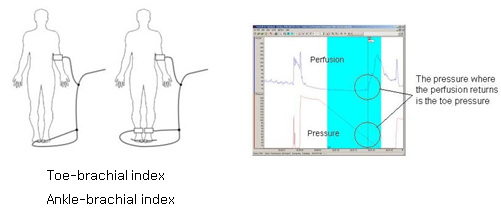
The Laser Doppler in combination with the PF5050 Pressure Unit make vascular tests like Toe Pressure (Digital Systolic Blood Pressure), Skin Perfusion Pressure, Post Occlusive Reactive Hyperemia (PORH) and Pulse Volume Recording - PVR (Air Plethysmography) more accurate and reliable.
|
| PF 480 Perilont Microphamaclogy System |
By Bertil Gazelius(PhD,DDS)
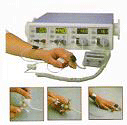
Using lontophoresis minute volumes of drugs can be non-invasively administered in a controlled fashion. The vascular responses are measured by laserDoppler.
lontophoresis is a technique to enhance the transport of drug ions across tissue barrier. Combined with laser Doppler, lontophoresis is a valuable tool for diagnosis of for example vascular diseases.
|
Laser Doppler Probes
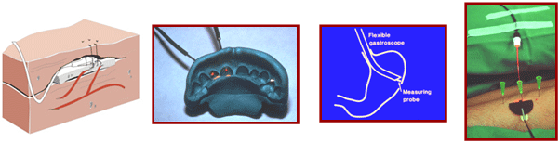 |
Perimed’s wide selection of Probes
|
General Probe Information
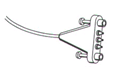
(Connect for 300-series)
(Connect for 400-series)
|
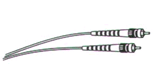
The 300-series probes are designed to fit the PeriFlux PF 2B and PF 3. The 400-series probes are designed for the PeriFlux System 4000 and PeriFlux System 5000. Probes have fibre optic cable lengths of 2.50 m (other lengths available) and are usually available from stock. |
|
PF 1000 Calibration Device
|
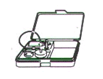
Calibration device including Motility Standard and zeroing disc for PeriFlux instruments. |
|
Probe Holders and Adhesive Tapes
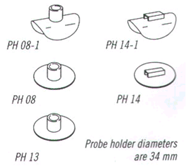
The probe holders are fixed to the skin using Double-Sided Adhesive Tapes. |
| PH 08-1 |
Shaped probe holder (e.g. for digits) for PROBE 301,308,312,401,408,412. |
| PH 14-1 |
Shaped probe holder (e.g. for digits) for angled probes PROBE 314,414. |
| PH 08 |
Straight probe holder for PROBE 301,308,312,401,408,412. |
| PH 13 |
Straight probe holder for integration probes PROBE 313,413. |
| PH 14 |
Probe holder for angled probes PROBE 314,414. |
|
Double-sided Adhesive Tapes
|
| PF 105-1 |
Adhesive rings diameter 32 mm. |
| PF 105-2 |
Adhesive rings diameter 22 mm. |
| PF 105-3 |
Adhesive strip 15×25 mm. |
|
|
PROBE 401 (301) Angled Probe
|
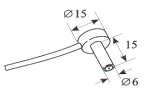
Multi-purpose probe usually used for skin measurements. The angular cable arrangement simplifies fixation to the body. probe holder PH 08, Ph 08-1. see also PROBE 408. Fibre separation : 0.25 mm. |
|
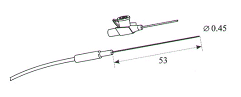
PROBE 402 (302) Needle Probe
|
Intended for acute invasive measurements.
The tip (diam. 0.45mm) may be introduced directly into the tissue to the desired depth or inserted through a 22 G/0.6 I.D. cannula. For human muscle measurements, the PROBE 418 with Microtips and the PH 18 Fixation device are preferable. See also PROBE 411 and 418 with Microtips.
Fibre separation : 0.15 mm. |
|
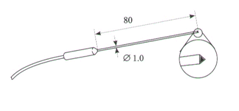
Probe 403 (303) stainless steel Probe
|
The support is designed to fit in a micromanipulator or laboratory stand for exact positioning. Convenient for measurements on animal organs or in body cavities. See also PORBE 410.
Fibre separation : 0.25 mm. |
|
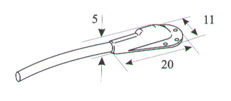
PROBE 404 (304) Suturable Angled Probe
|
The probe is designed to be sutured onto a flap. The low profile allows easy removal when used with buried flaps. The probe is made of epoxy to be rigid and flexible.
Fibre separation : 0.25 mm. |
|
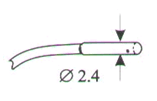
PROBE 406 (306) Angled Endoscopic Probe
|
Can be inserted through the biopsy channel of an endoscope. Reads perpendicularly.
See also PROBE 409.
Fibre separation : 0.25 mm. |
|
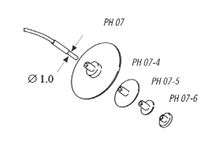
PROBE 407 (307) Small Straight Probe with Miniholders
|
The soft, flexible design of the fibre line reduces the influence of artifacts from moving subjects. The probe fits into different types of small probe holders called Miniholders. The different types of Miniholders are suitable for different tissues.
Fibre separation : 0.25 mm. |
| PH 07 |
The Miniholder has a thin latex sheet that adheres to wet surfaces. Intended for use on liver, kidney and intestine. Diameter 20 mm. |
| Ph 07-4 |
The probe holder is fixed to skin using double-sided adhesive strips (PF105-3).
Intended for measurements on skin, particularly small areas like toes and fingers. Diameter 10 mm. |
| PH 07-5 |
Similar to PH 07-4, but the smaller diameter is suitable for use on small fingers
and toes. Diameter 5 mm. |
| PH 07-6 |
Glued to hard tissues like teeth and bone. The low, smooth profile allows the
miniholder to be glued onto a tooth and left in place for extended periods, thus
enabling repeated measurements on the same vascular bed. Diameter 4 mm,
height 2.5 mm. |
|
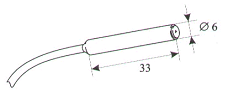
PROBE 408 (308) Standard Probe
|
Multi-purpose probe usually used for skin measurements. Probe holder PH 08, PH 08-1.
See also PROBE 401.
Fibre separation : 0.25 mm. |
|
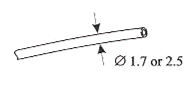
PROBE 409 (309) Straight Endoscopic Probe
|
Intended for gastrointestinal measurements of mucosal blood perfusion. The Probe can be inserted through the biopsy channel of an endoscope. Two diameters are available to fit different biopsy channels. See also PROBE 406. Fibre separation : 0.25mm |
|
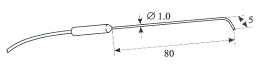
PROBE 410 (310) Angled Stainless Steel Probe
|
The support is designed to fit in a micromanipulator or laboratory stand for exact positioning. Convenient for measurements on animal organs or in body cavities. Similar to PROBE 403 but the angled tip of the probe makes tissues such as nasal and oral mucosa more easily accessible.
Fibre separation : 0.25 mm. |
|
PROBE 411 (311) Needle Probe for Micromanipulator
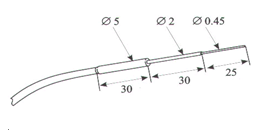
|
Intended for acute invasive measurements. The support is designed to fit in a micromanipulator or laboratory stand for exact positioning. The tip is thin (0.45mm) for easy penetration of tissue, for example animal brain. See also PROBE 402.
Fibre separation : 0.15 mm. |
|
PROBE 412 (312) Deep Measurement Probe
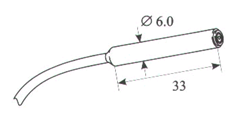
|
(Previously called Multireceiver Probe.) The probe has a 1.2 mm separation of fibres to allow a wider and deeper measurement range (larger volume) than a standard probe. Probe holders PH 08, PH 08-1.
Fibre separation : 1.2 mm. |
|
PROBE 413 (313) Integrating Probe
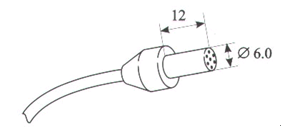
|
Intended for areas with large spatial variation, for example forearm. The measuring area of the probe has seven "probe tips". Each of the "probe tips" has a transmitting fibre and a receiving fibre. The values from each "probe tip" are optically integrated into one value. This method allows measurement over a larger area and thereby improves reproducibility in tissues with spatial value. This method allows measurement over a larger area and thereby improves reproducibility in tissues with spatial variations in blood perfusion. Probe holder PH 13. Fibre separation : 0.25 mm |
|
PROBE 414 (314) Angled Small Probe
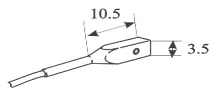
|
Suitable for skin measurements as well as in cavities. Probe holder PH 14, PH 14-1.
Fibre separation : 0.25 mm. |
|
PROBE 416 (316) Dental Probe
|
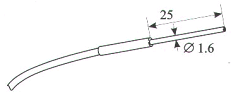
Designed for measurements on teeth. For this application, the probe is fixed by drilling a hole in a "splint" about 1.5mm from the gingiva. See also PROBE 407 together with PH 07-6.
Fibre separation : 0.25 mm |
|
Probe 418 (318) Master Probe
See information about disposable microtips on the next page.
|
PROBE 420 (320) Flexible Straight Probe
|
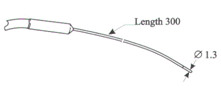
Suitable for measurements in parenchyma. It fits into commercially available skull screws. The probe can also be introduced into muscle or other tissues using a cannula.
Fibre separation : 0.25 mm. |
|
PROBE 424 (324) Gastric Probe
|
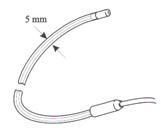
The probe is intended for gastric mucosal perfusion measurement. The probe is introduced through the nose or orally. A metal wire allows positioning of the probe using X-ray. Introduction length 800mm. |
|
 |
PROBES WITH DISPOSABLE MICROTIPS FOR MINIMAL INVASIVE MEASUREMENTS |
Probe 418-x (318-x) Master Probe
|
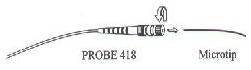
The probe is designed for simple connection and disconnection of the microtip.
Two different versions are available depending on tissue property and fibre length.
PROBE 418-1 (318-1) Used for normal tissue.
PROBE 418-2 (318-2) Used for very dark tissue (e.g.kidney). |
|
MT B500-0 Straight Microtip
|
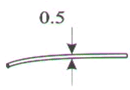
Intended for measurements in tissues. The 0.5mm flexible microtip can be inserted into the tissue with a 22 G/0.6 I.D. cannula. The tips are available with lengths of 80, 120 and 240mm. Other lengths are available. Maximum lengths : wavelength 633 nm : 3000 mm, wavelength 780 nm : 1000 mm. |
|
MT A500-0 Straight Microtip with Slanted Tip
|
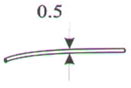
Intended for measurements in tissues. The distal end of the tip has been polished with a slight angle to improve the optical properties. This results in a higher signal-to-noise ratio than ordinary straight microtips. The 0.5mm flexible microtip can be inserted into the tissue with a 22 G/0.6 I.D. cannula. The tips are available with lengths of 80, 120 and 240mm. Other lengths are available. Maximum lengths : wavelength 633 nm : 1200 mm, wavelength 780 nm : 300 mm. |
|
PH 18 Fixation Device for Microtip
|
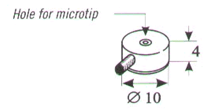
The fixation device is secured onto skin using adhesive tape or glued to a skull. The microtip is inserted into the tissue with a 22 G/0.6 I.D. cannula and secured with the locking screw. Using this device, the microtip will remain in its original position and artefact and unnecessary trauma to the tissue are avoided. |
|
|
| EXAMPLES OF SPECIAL MICROTIPS |
MT B500-2 Angled Microtip with Adhesive Properties
|
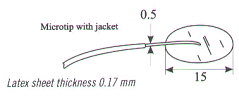
Intended for surface measurements. The small latex sheet adheres to a moist surface and keeps the probe in place. As an alternative, probe 407 (307) with miniholder can be used. Maximum lengths : wavelength 633 nm : 1200 mm, wavelength 780 nm : 300 mm. |
|
MT B500-3x EEG Probe and LD Microtip
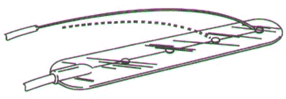
|
Intended for surface measurements. An EEG probe (provided by the customer) can be modified to contain one or more microtips for laser Doppler measurements. The combined probe can be positioned on the cortex during a craniotomy, or pushed into position through a burr hole. Maximum lengths : wavelength 633 nm : 1200 mm, wavelength 780 nm : 300 mm.
Other combinations can be supplied |
| MT B500-31 |
EEG probe combined with one microtip |
| MT B500-32 |
EEG probe combined with two microtips |
| MT B500-33 |
EEG probe combined with three microtips |
| MT B500-34 |
EEG probe combined with three microtips |
|
|
| EXAMPLES OF CUSTOM-MADE PROBES |
PROBE 415-135 Two-channel Flexible Angular Intestinal Probe
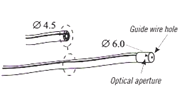
|
Intended for gastric and intestinal mucosal perfusion measurements. The probe is introduced through the nose. A blue radiopaque line follows the lumen and simplify the positioning of the probe using x-rays. A central lumen allows introduction of a guidewire. The two probes read perpendicularly. The probe also contains several empty channels that can be used for instance for pressure measurements.
Fibre separation : 0.25 mm.
|
|
PROBE 423 (323) with Electrical Stimulation and Drug Delivery
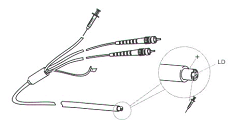
|
Intended for endoscopic measurements, for example in the lungs. Electrical pulsation and/or drug delivery are used for stimulation of the tissue perfusion.
Fibre separation : 0.25 mm. |
|
PROBE 425 (325) Rotating Probe
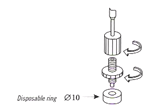
|
Intended for measurements on rat brain, the rotation probe allows measurements while the animal is conscious. The animal can move with the probe in place. The disposable ring is cemented or screwed onto the skull. The probe has one rotating part that rests on a mom-rotating glass rod. The glass rod is available in different lengths to allow invasive or cortical measurements. Other Rotating Probes are available. |
|
PROBE 415-7 Multichannel Probe for skin Measurements
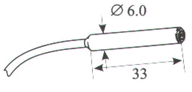
|
Intended for measurements on skin. Probes are made with 2 or 3 different fibre separations and can simultaneously use different wavelengths. With this probe, the perfusion at different depths can be measured simultaneously. (See page 2, "multi-channel Probes".) Probe holder PH 08, PH 08-1. Information on fibre separation on request.
|
|
PROBE 415-49 Multichannel Probe for Micromanipulator
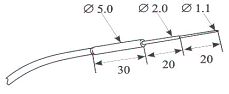
|
Specifications as above, but the support is designed to fit into a micromanipulator or a laboratory stand for exact positioning, e.g. on a rat brain. Information on fibre separation on request. |
|
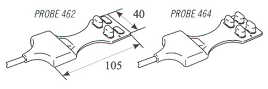
| Probe 462 2-channel flexible thermostatic laser Doppler Probe |
Probe 464 4-channel flexible thermostatic laser Doppler Probe
|
The probes are designed to be placed directly on a burn wound. They have two or four laser Doppler channels for perfusion monitoring. Heating elements surround each optical aperture. These elements are heated equally by the PF 4005 PeriTemp. The probes are flexible to adapt to the measuring site.
Fibre separation : 0.25 mm. |
|
PROBE 415-127 Wet Surface Probe
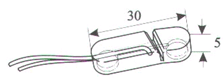
|
The probe is designed to be fixed to a tissue using a small vacuum. Examples of tissues are kidney, liver and intestine (serosa). The two vacuum chambers are evacuated using a pump.
Fibre separation : 0.25 mm. |
|
|
HEATED PROBES |
PF 450 (350) Thermostatic Probe Holder
|
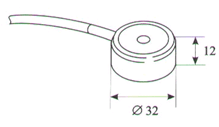
The thermostatic probe holder is used together with several different laser Doppler Probes. The probes listed below will fit in the centre hole of the thermostatic probe holder. The thermostatic probe holder is fixed to the skin using double-sided adhesive rings.
PROBE 401, 408, 412, 413-fits into thermostatic probe holder PF 450.
PROBE 301, 308, 312, 313-fits into thermostatic probe holder PF 350.
Key feature : The PF 450 (350) Thermostatic Probe Holder can host several different types of Probes. |
|
PROBE 455 (355) Angled Thermostatic Laser Doppler Probe
|
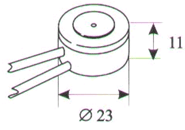
A combined laser Doppler and thermostatic probe used for local heat provocation while blood perfusion is measured. Double-sided adhesive rings (PF 105-2) are used for fixation. The probe is water-resistant. Similar to PROBE 457 (357) but intended for use on larger areas, e.g. dorsum of foot or forearm. Fibre separation 0.25 mm.
Key feature : The optical fibres are integrated in the heated area and thus the whole tissue area under the probe will be heated. |
|
PROBE 457 (357) Angled Small Thermostatic Laser Doppler Probe
|
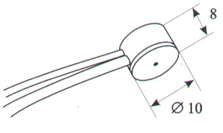
A combined laser Doppler and thermostatic probe used for local heat provocation while blood perfusion is measured. Double-sided adhesive strips (PF 105-3) are used for fixation. The probe is water-resistant. Similar to PROBE 455 (355) but intended for use on small areas, e. g. toes and fingers, but can also be used elsewhere. Fibre separation 0.25 mm.
Key feature : The optical fibres are integrated in the heated area and thus the whole tissue area under the probe will be heated. |
|
|
TEMPERATURE MEASUREMENT SENSORS |
SENSOR 442 Skin Spot sensor
|
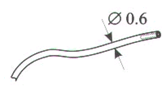
Measures temperature in an area with a diameter of about 0.6 mm. The sensor is fixed to the skin using tape.
Typical time constant : 3 sec. |
|
| <Please contact us if you can not find a probe that fits your particular need as we can custom-design probes of almost any shape and size.> |